John Carpenter’s The Thing was the movie that was supposed to launch him into the Hollywood elite. Instead, it nearly destroyed his career.
As Carpenter’s first production made with the full backing and budget of a major Hollywood studio, The Thing represented an enormous opportunity. Universal Pictures entrusted the director of Halloween, The Fog, and Escape from New York with approximately $15 million to reinvent a science-fiction classic.
When the film opened in 1982, critics attacked it, audiences rejected it, and Universal held Carpenter responsible. Carpenter later described it as an enormous failure and said he was fired from another studio project. His Hollywood trajectory changed almost overnight. The Guardian
Four decades later, The Thing is recognized as one of the greatest horror films ever made.
The studio wanted a hit. Carpenter gave it an immortal nightmare.
Affiliate disclosure: This review contains an Amazon affiliate link. If you make a purchase through it, Weird Howard Productions may earn a commission at no additional cost to you. As an Amazon Associate I earn from qualifying purchases.
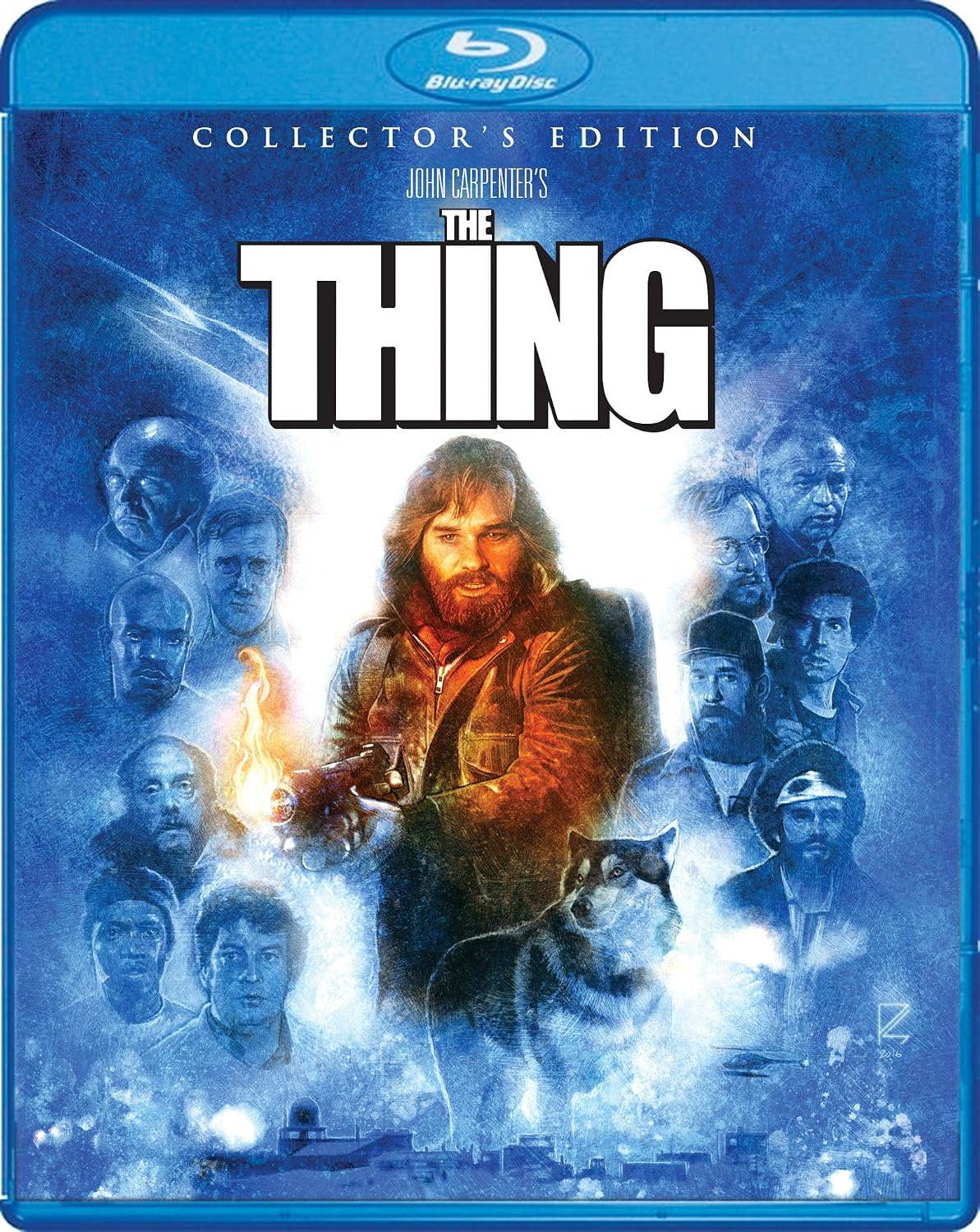
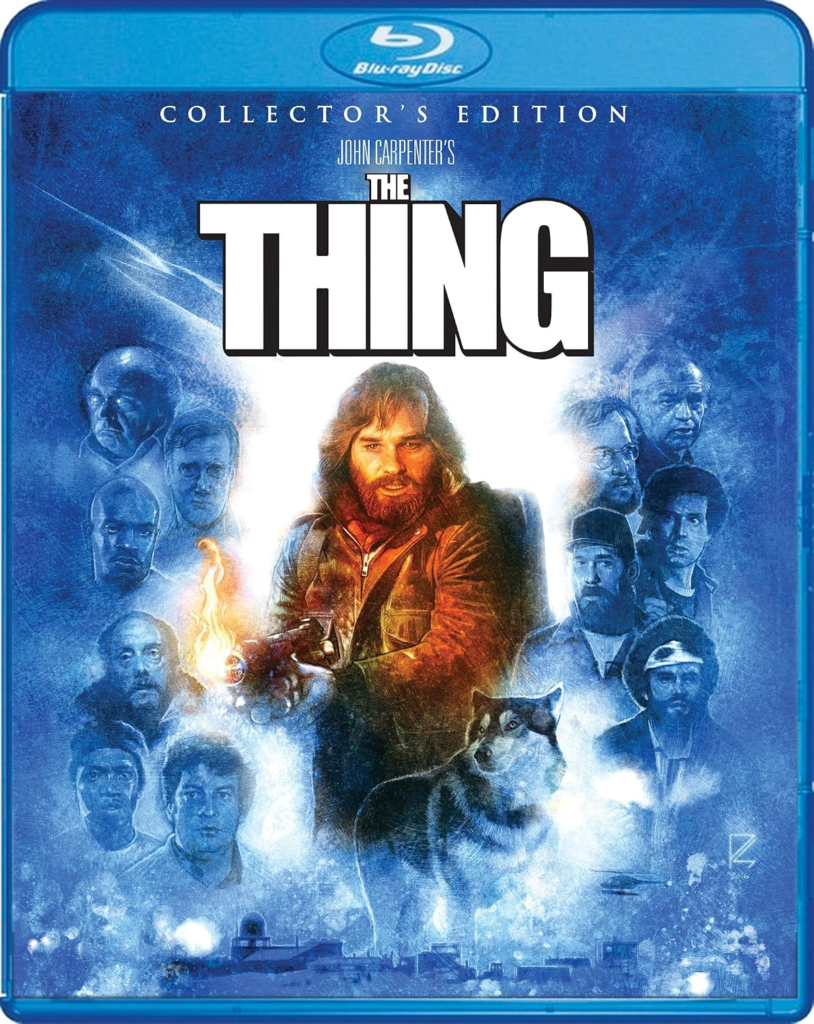
Purchase John Carpenter’s The Thing on Blu-ray through Amazon
Paranoia at the End of the World
Based on John W. Campbell Jr.’s 1938 novella “Who Goes There?”, The Thing follows a group of American researchers stationed in Antarctica. Their isolation is interrupted when a Norwegian helicopter pursues a seemingly ordinary dog across the frozen landscape.
The dog is not ordinary.
It carries an alien organism capable of absorbing, imitating, and replacing other living creatures. Once it enters the station, nobody can be certain who remains human.
Carpenter understands that the most frightening version of the monster is not the one standing in front of us. It is the one sitting beside us.
Kurt Russell plays helicopter pilot R.J. MacReady with a mixture of exhaustion, suspicion, and reluctant authority. He is not a conventional hero arriving with answers. He is simply the person willing to keep asking questions after everyone else has begun reaching for a flamethrower.
The film slowly removes every source of safety. Communication disappears. Transportation is sabotaged. Trust collapses. The Antarctic weather becomes another locked door.
The creature does not merely attack the station. It turns every survivor into a possible extension of itself.
Nothing Else Looks Like The Thing
Rob Bottin was only 22 when he began supervising the creature effects. He worked for more than a year, reportedly maintaining a punishing schedule that eventually resulted in hospitalization for exhaustion.
His work remains astonishing.
The creature in The Thing has no permanent anatomy. It produces whatever mouth, limb, eye, claw, or tentacle it needs at that moment. A human chest becomes a set of jaws. A severed head grows legs. A dog unfolds into something that appears to remember several million years of biological mistakes at once.
Bottin’s creations were built from prosthetics, puppets, hydraulics, cables, foam latex, mechanical rigs, reverse photography, and gallons of fluid. Stan Winston and his team contributed to the famous kennel transformation when Bottin’s workload became overwhelming.
These effects are not polished in the modern digital sense. They shake, stretch, drip, and occupy physical space. Actors can react to something standing in the room with them. Light touches its surfaces. Slime catches on its teeth. Its flesh appears heavy, wet, and horribly alive.
Nothing quite like it had been attempted on that scale before, and few productions have attempted it since.
Modern visual effects can create creatures with greater freedom of movement, but Bottin’s Thing possesses a quality that computer imagery often struggles to reproduce. It appears physically present and biologically wrong.
The creature is disgusting because it looks touchable.
The Blood Test
The film’s greatest scene does not rely on an enormous transformation. It begins with the surviving men tied together while MacReady tests samples of their blood with a heated wire.
The scene works because Carpenter has already taught us to distrust everyone.
Each test tightens the tension. The camera studies faces. Ennio Morricone’s minimal score pulses beneath the silence. MacReady knows his theory may be wrong, the prisoners know he may be losing his mind, and the audience knows something must eventually react.
When it happens, the effect is explosive.
This sequence contains the entire movie in miniature. Intelligence confronts the unknown, develops a reasonable experiment, and discovers that knowledge does not create safety. It only reveals where the monster is hiding.
At the Mountains of Madness
The Thing is not an adaptation of H.P. Lovecraft’s “At the Mountains of Madness.” Its direct source is Campbell’s “Who Goes There?”, and there is no definitive evidence that Carpenter or Campbell deliberately borrowed the story from Lovecraft.
The connection is nevertheless impossible to ignore.
Lovecraft’s novella follows a scientific expedition into Antarctica, where researchers discover the remains of ancient extraterrestrial beings preserved beneath the ice. Their investigation reveals that humanity is only a recent and insignificant arrival in a universe inhabited by civilizations of incomprehensible age.
Both stories use Antarctica as more than a location. It is an environment where human beings cannot survive without technology, cooperation, and trust. Remove any one of those things and the landscape becomes lethal.
The Thing also resembles Lovecraft’s shoggoths, enormous protoplasmic organisms able to alter their forms and produce temporary eyes, limbs, and organs. A shoggoth and the Thing are not identical creatures, but they share the same terrible rejection of stable anatomy.
They also produce the same philosophical horror.
The terror is not simply that an alien exists. The terror is that biology, identity, and human importance may be temporary arrangements. The creature can copy a person perfectly enough that the imitation may not know what it is until threatened.
Lovecraft’s explorers discover that human history is a footnote. Carpenter’s characters discover that being human may be nothing more than a pattern that can be copied.
Why Audiences Rejected It
The Thing arrived in theaters only two weeks after Steven Spielberg’s E.T. the Extra-Terrestrial.
Spielberg offered audiences a gentle visitor from the stars who healed wounds, befriended children, and wanted to go home. Carpenter offered an alien that tore bodies apart, erased identity, and could not be reasoned with.
Audiences chose hope.
Contemporary critics frequently described The Thing as excessive, ugly, and empty. Its practical effects, now praised as masterpieces, were treated as evidence that the film cared more about gore than character.
Time has reversed that judgment.
The violence is not empty. Every transformation reveals something about the creature’s capabilities and makes the remaining characters more suspicious. The effects are part of the storytelling. Each new form destroys another assumption about what the Thing can become.
Carpenter was punished for giving audiences a movie they were not ready to accept.
The Perfect Cosmic Horror Ending
Most horror films end by restoring order. The monster is killed, the survivors escape, and the audience is allowed to believe that the nightmare has boundaries.
The Thing offers no such comfort.
Its final moments leave us with exhaustion, uncertainty, and two men watching the station burn. The immediate threat may be over, but neither character can trust the other. Rescue may never arrive. If it does, rescue could carry the creature back to civilization.
The ending works because cosmic horror should not explain everything.
Human beings want answers. The universe is under no obligation to provide them.
The Blu-ray Extras Are Worth the Expedition
The Blu-ray release gives fans an opportunity to examine how Carpenter and his crew constructed the nightmare. The linked edition includes several worthwhile supplements, but the essential extra is the feature-length commentary with John Carpenter and Kurt Russell.
Their conversation is relaxed, funny, and refreshingly free of academic distance. Carpenter and Russell discuss the production like two collaborators remembering an exhausting adventure. Their chemistry makes the commentary entertaining even when they wander away from technical details.
The edition also includes John Carpenter’s The Thing: Terror Takes Shape, an extensive documentary about the production. It features interviews with Carpenter, Russell, Rob Bottin, matte painter Albert Whitlock, and other members of the cast and crew.
The documentary explores the adaptation, location work, creature development, physical effects, production design, and the film’s difficult reception. Bottin’s contributions are especially fascinating. Seeing the machinery, puppetry, sculptures, and human labor behind the transformations makes the finished effects even more impressive.
Additional features include outtakes, the theatrical trailer, and picture-in-picture material that can be viewed alongside the film. The supplements turn the release into more than another way to watch The Thing. They provide a practical education in building suspense, photographing physical effects, and creating a monster without giving it a permanent shape.
For horror filmmakers and practical-effects fans, Terror Takes Shape and the Carpenter-Russell commentary are nearly worth the purchase by themselves.
Final Verdict
The Thing is a nearly perfect combination of science fiction, body horror, mystery, and cosmic dread. Its characters behave intelligently, its practical effects remain unmatched, and its Antarctic setting turns isolation into a weapon.
Most importantly, the film understands that the unknown becomes less frightening when it is fully explained. Carpenter tells us just enough to recognize the danger while leaving its origin, history, and ultimate survival uncertain.
The movie that nearly destroyed John Carpenter’s career became the film that proved he was ahead of his time.
Rating: 5 out of 5 tentacles