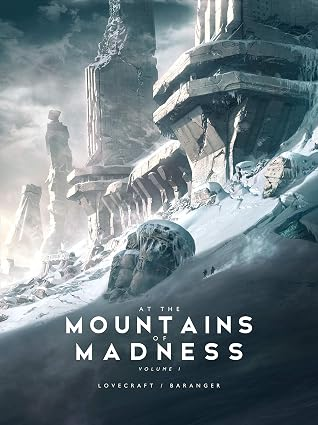
Some books are meant to be read. François Baranger’s illustrated edition of H.P. Lovecraft’s At the Mountains of Madness is meant to be entered.
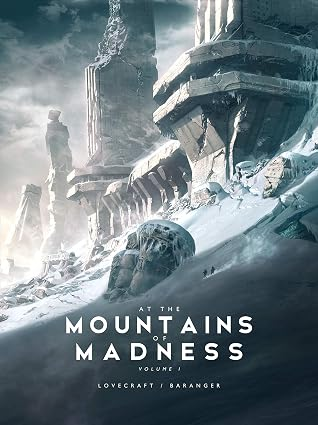
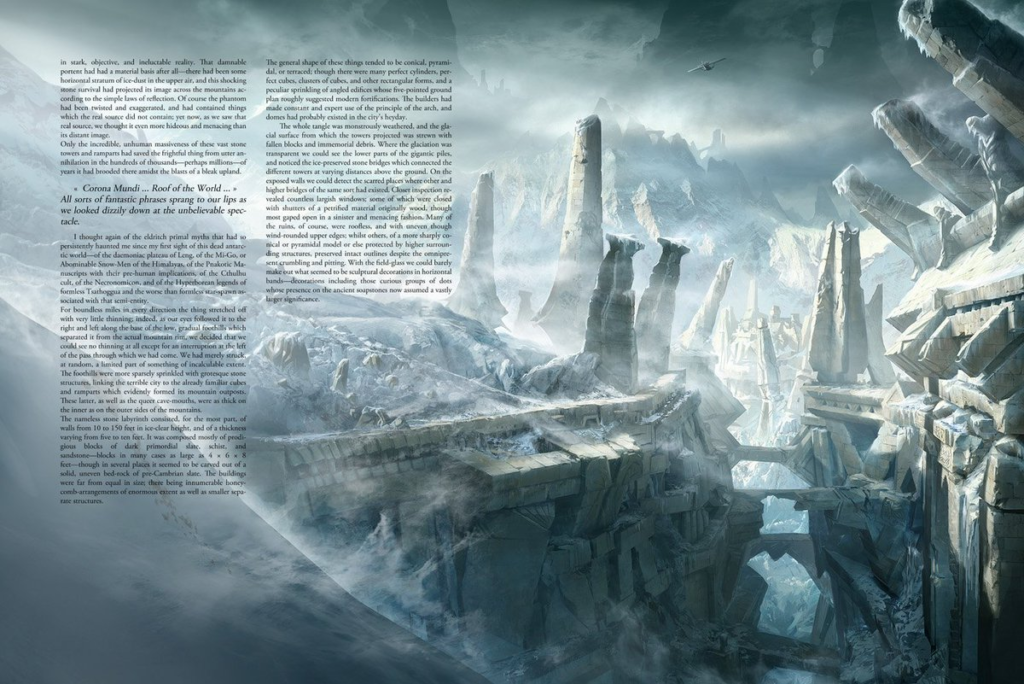
Published across two enormous hardcover volumes, Baranger’s adaptation preserves Lovecraft’s complete story while surrounding it with cinematic paintings of Antarctic wastes, impossible architecture, prehistoric organisms, and things that should have remained beneath the ice. This is not a conventional graphic novel. Lovecraft’s prose remains the guide, but Baranger gives that prose scale, color, atmosphere, and monstrous physical presence.
For Lovecraft collectors, cosmic horror readers, and anyone still mourning the Guillermo del Toro adaptation that Hollywood never allowed us to see, these volumes may be the closest thing we have to a finished movie.
Affiliate disclosure: This review contains Amazon affiliate links. If you make a qualifying purchase through one of these links, Weird Howard Productions may receive a commission at no additional cost to you. As an Amazon Associate, we earn from qualifying purchases.
A Warning from the End of the World
Written in 1931 and first serialized in Astounding Stories in 1936, At the Mountains of Madness is presented as the testimony of Professor William Dyer of Miskatonic University. Dyer is attempting to prevent another scientific expedition from entering the Antarctic interior.
He knows what is waiting there.
During an earlier expedition, Dyer and his companions discovered evidence of a civilization that existed before humanity. What begins as a story of exploration and scientific ambition becomes a descent through layers of buried history. Humanity is reduced to a recent accident in a world that has belonged to stranger and older forms of life.
The novella helped establish a pattern now found throughout cosmic horror: educated people travel into the unknown, make a discovery that should transform human knowledge, and slowly realize that knowledge itself may be the enemy.
François Baranger Makes Scale the Monster
Baranger’s greatest achievement is not simply illustrating Lovecraft’s creatures. It is illustrating insignificance.
Volume One opens the world with immense fields of blue-white ice, distant aircraft, temporary camps, and human figures that appear almost microscopic against Antarctica. Machinery that would seem powerful anywhere else becomes fragile among the mountains. The expedition’s planes, tents, sledges, drilling equipment, and radio stations give the story a convincing period reality, which makes the arrival of the impossible feel even more disruptive.
The frozen landscapes are rarely empty. Shadows gather inside the ice. Black peaks cut through the pale sky. Strange geometric formations appear where natural geology should be. Baranger repeatedly draws the eye toward something distant and uncertain, inviting the reader to lean closer even when every survival instinct says to look away.
His paintings of the preserved specimens are particularly effective. The Elder Things are not treated as generic movie monsters. Their radial bodies, star-shaped heads, folded wings, tubes, ridges, and unfamiliar symmetry make them look like organisms produced by a completely different history of evolution. They are grotesque, but they are also biologically persuasive.
That distinction becomes increasingly important. The deeper Dyer travels, the harder it becomes to think of these beings as monsters in the ordinary sense. They were explorers, scientists, builders, artists, and eventually victims of their own creations.
The large 10.5-by-14-inch format gives the paintings room to breathe. Design Studio Press describes Volume One as a 64-page hardcover, and this size is essential to the experience. The book wants to be opened across a table. Many of the images feel less like illustrations and more like production paintings recovered from an impossibly expensive film.
Volume Two Descends Beneath the Ice
Volume One contains the journey, the discoveries at the camp, and the first terrible evidence of what lies beyond the mountains. It does not contain the complete story. Readers will need Volume Two to follow Dyer and Danforth into the ancient city and reach the conclusion.
This is where Baranger’s work becomes truly monumental.
The city of the Elder Things stretches across the frozen landscape in cyclopean terraces, towers, cubes, cones, and structures that seem designed according to rules no human architect would recognize. Dyer and Danforth become tiny intruders inside an environment built for another species.
Inside the city, the mood changes from Antarctic adventure to archaeological nightmare. Vast passages vanish into darkness. Carved bas-reliefs cover the walls, recording millions of years of alien history. Baranger gives these chambers an oppressive physical weight. The stone looks ancient enough to remember the formation of continents.
One particularly ominous composition places the explorers near the entrance to the underground passages while the surrounding stonework forms a skull-like shape in the shadows. It is the sort of visual suggestion that works perfectly with Lovecraft. Nothing needs to leap from the darkness. The architecture itself seems to be warning them.
Then come the albino penguins, enormous and blind, wandering through the subterranean gloom. In another story they might provide a moment of absurdity. Here they are deeply disturbing because they prove that an entire hidden ecosystem has survived beneath the ice.
Finally, there is the shoggoth.
Baranger does not reduce it to a creature with a clean silhouette. It is an avalanche of living black matter, unstable eyes, wet reflections, and constantly forming anatomy. It fills the tunnel like a flood that has learned hunger. The explorers do not look like heroes confronting a monster. They look like animals fleeing a natural disaster.
According to the artist’s own description, Volume Two contains the complete remaining text and follows Dyer and Danforth into the underground labyrinth beneath the city. It is the more nightmarish of the two books, but its horror works because Volume One has already made us believe in the expedition.
The Story That Escaped into Popular Culture
At the Mountains of Madness has become one of the foundational texts of modern cosmic horror. Its influence can be felt whenever a story sends researchers into an isolated environment, uncovers evidence of a prehuman civilization, or confronts its characters with a discovery that destroys their understanding of life on Earth.
Films such as Alien, The Thing, and Prometheus share portions of its creative DNA, even when they are not direct adaptations. Each places human explorers in hostile isolation and allows scientific curiosity to uncover something ancient, biological, and catastrophic.
Its descendants also appear throughout games, comics, tabletop role-playing adventures, audio dramas, and stories about forbidden expeditions. Video games have become particularly well suited to Lovecraftian horror because they let the audience personally cross the threshold. The player does not merely watch someone enter the ancient ruin. The player must open the door.
What makes Mountains so enduring is that its mysteries grow larger as they are explained. Dyer learns an astonishing amount about the Elder Things, their civilization, their wars, and their creations. Yet every answer reveals another layer of history beneath it. Even the Elder Things were afraid of something.
The Guillermo del Toro Movie That Almost Happened
Guillermo del Toro spent years trying to turn At the Mountains of Madness into a large-scale feature film. The project reached a remarkably advanced stage at Universal, with James Cameron involved as a producer and Tom Cruise prepared to star.
Del Toro envisioned it as an enormous, visually ambitious horror production shot in 3D. The estimated budget was around $150 million, but he also wanted the freedom of an R rating. Universal feared that such an expensive adult horror film would not reach the audience required to recover its production and marketing costs.
In March 2011, the project lost its path to production. Del Toro told The New Yorker that the rating had killed it, while the magazine reported that Universal was concerned about both its likely R rating and massive budget. The proposed film would have combined blockbuster resources with the discomfort and bleakness of serious horror, which was exactly what made it exciting and financially terrifying. Read the production account in The New Yorker.
Tom Cruise was not merely a piece of wishful casting. Contemporary reporting stated that Cruise was ready to star, with Cameron producing.
The film remains unrealized. Del Toro has continued to discuss the project and has considered different ways of approaching it, but as of 2026 it still belongs to that haunted category of legendary movies that almost escaped development. In a 2026 interview, he said he still had hope for the adaptation, even as it remained among his long-unmade projects. Read the interview in The Guardian.
That history makes Baranger’s books feel even more valuable. His illustrations possess the scale of concept art for a major film, but they are not restrained by studio budgets, ratings, actors, or market projections. The alien city can be as vast as Lovecraft imagined it. The shoggoth does not need to be simplified for a manageable effects sequence. The mountains can loom higher than anything a location scout could find.
These books are not a replacement for del Toro’s movie. They may, however, be the second-best thing we will ever receive.
Begin with The Call of Cthulhu
Baranger began this series of monumental Lovecraft editions with The Call of Cthulhu. It is an ideal introduction to his approach and includes his visions of forgotten cults, storm-darkened seas, the impossible city of R’lyeh, and Cthulhu rising with a sense of scale that few artists have captured successfully.
Readers who enjoy the two Mountains volumes should consider adding it to the same shelf.
Buy François Baranger’s illustrated The Call of Cthulhu
No Time to Cross Antarctica in Print?
Lovecraft’s dense language is rewarding, but it demands attention. For readers who would rather experience the expedition while commuting, working, or sitting safely beside a fire, an audiobook can be an excellent alternative.
The narrated format also suits the story’s structure. Dyer’s account becomes a desperate spoken warning from someone who has returned from the end of the world and knows that others are preparing to repeat his mistake.
Listen to At the Mountains of Madness through Audible
Final Verdict
François Baranger’s At the Mountains of Madness is not the most portable way to read Lovecraft. It is not the least expensive, either. The complete story requires two oversized books, and these are volumes that deserve careful handling and plenty of shelf space.
They are also among the most convincing visual interpretations of Lovecraft ever published.
Baranger understands that cosmic horror is not only about tentacles, teeth, or slime. It is about scale, time, distance, and the terrifying possibility that humanity has misunderstood its place in the universe. His Antarctic skies feel endless. His ruins feel older than memory. His creatures possess anatomy, history, and purpose.
For devoted Lovecraft readers, horror art collectors, filmmakers, creature designers, and anyone who wants to see the Elder Things’ city without waiting for Hollywood, both volumes are essential.
Weird Howard Rating: 5 out of 5 Elder Signs
Buy the complete illustrated expedition:
Pack a lantern. Bring extra fuel. Do not follow the footprints beneath the ice.